
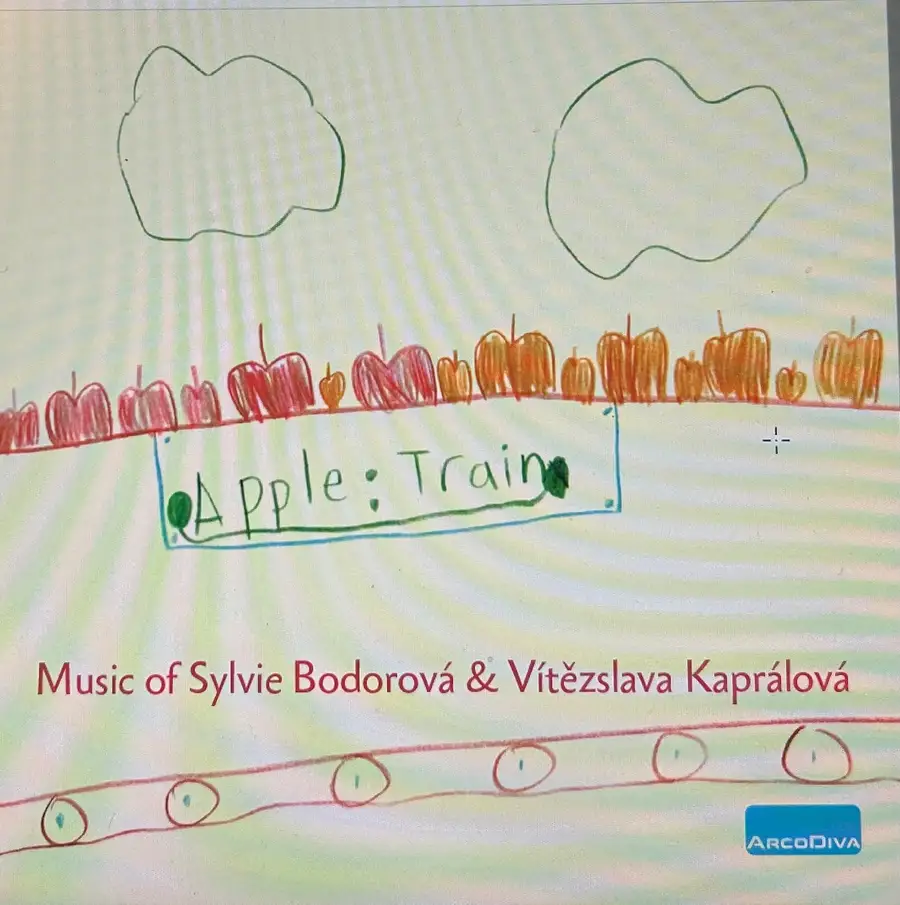
Apple Train Works by Bodorová and Kaprálová
Škampa Quartet, Barbora Haasová – flute, Alena Hron – conductor, Canticum Ostrava, Jurij Galatenko – choirmaster
ABOUT
TEXT BY NAXOS:
The brief but intense life of Czech composer and conductor Vítězslava Kaprálová (1915–1940) was set between the two world wars in the period of the First Czechoslovak Republic to whose modernist movement she belonged. Kaprálová’s creative development began in her hometown of Brno, stimulated first by the cultured environment of her own family and its circle of friends, among whom were some of the finest musicians and music scholars of the new republic. Her natural talent was recognized early and nurtured by her parents who both played an important role in Kaprálová’s early musical development. Her mother Vítězslava, born Uhlířová (1890–1973), was a qualified voice teacher; her father, Václav Kaprál (1889–1947), was a composer (a pupil of Leoš Janáček), teacher, pianist, choirmaster and music editor. The city’s conservatory, where young Kaprálová pursued a double major in composition and conducting from 1930–1935, provided a solid foundation for her education, which was further advanced by her studies under composer Vítězslav Novák and conductor Václav Talich at the Prague Conservatory from 1935–1937. Following her graduation from the conservatory’s Master School in 1937 and aided by a French government scholarship, Kaprálová moved to Paris, where she continued her studies in conducting with Charles Munch at the École normale de musique, while also taking private lessons in composition with Paris-based Czech composer Bohuslav Martinů. Martinů’s often cited influence on Kaprálová’s musical development is overestimated, however, for the music of Igor Stravinsky and her father in particular exerted as strong an influence on the young composer. There is no doubt that when Kaprálová died in 1940, possibly from typhoid fever, just two months after marrying Alphonse Mucha’s son, the world of classical music was robbed of a burgeoning talent and a highly individual voice.
Like her composer father, Kaprálová was drawn to piano as her natural instrument, and piano compositions are well represented in her relatively large creative output that includes about fifty compositions. Piano also played a crucial role in her music as a compositional tool with which she experimented in both smaller and larger forms. It is therefore not surprising that her most original and sophisticated works are for this instrument: from her Sonata appassionata and Piano Concerto in D Minor to April Preludes and Variations sur le carillon de l’église St.-Etienne-du-Mont (and the Martinů–influenced, neoclassical Partita in which piano also plays an important percussive role). Piano compositions arguably represent the best of Kaprálová’s music which abounds in fresh and bold ideas, humour, passion and tenderness, and is imbued with youthful energy.
TRACKLISTING
FEATURING ALENA HRON:
11. Kaprálová: Vítězslava Kaprálová Dva ženské sbory, Op. 17 I. Vězdička / Two Choruses for Women’s Voices a cappella op. 17 Little Star
Canticum Ostrava, Alena Hron, Jurij Galatenko
12. Kaprálová: Vítězslava Kaprálová Dva ženské sbory a cappella op. 17 / Two Choruses for Women’s Voices a cappella op. 17 / II. Potpoliš
Canticum Ostrava, Alena Hron, JurijGalatenko
FULL TRACKLIST:
Bodorova: Sylvie Bodorová I. Déšť / Rain from Apple Train Song Cycle for Soprano and Piano with Dance (2008–2009)
Bodorova: Sylvie Bodorová II. Modlitba stará-stará from Apple Train Song Cycle for Soprano and Piano with Dance
Bodorova: Sylvie Bodorová III. Chci tě slyšet / I want to hear it from Apple Train from Song Cycle for Soprano and Piano with Dance
Bodorova: Sylvie Bodorová IV. Uspávanka s počítáním ovcí / Falling asleep by counting sheep from Song Cycle for Soprano and Piano with Dance
Bodorova: Sylvie Bodorová V. Kulatý svět / Round World from from Song Cycle for Soprano and Piano with Dance
Bodorova: Sylvie Bodorová VI. Smuténka / The sad girl from Song Cycle for Soprano and Piano with Dance
Bodorova: Sylvie Bodorová VII. Modlitba za vodu / Prayer for water from Song Cycle for Soprano and Piano with Dance
Kaprálová: Leden, UP 0256
Kaprálová: Vítězslava Kaprálová Potkali se včera lidé dva / Two people met yesterday
Kaprálová: Vítězslava Kaprálová Až jednoho dne se budeš ptát / One day you will ask
Kaprálová: Vítězslava Kaprálová Dva ženské sbory, Op. 17 I. Vězdička / Two Choruses for Women’s Voices a cappella op. 17 Little Star
Kaprálová: Vítězslava Kaprálová Dva ženské sbory a cappella op. 17 / Two Choruses for Women’s Voices a cappella op. 17 / II. Potpoliš
Kaprálová: Vítězslava Kaprálová Karlu Čapkovi Melodram pro recitaci, housle a klavír / Melodrama for reciter, violin and piano
Kaprálová: Vítězslava Kaprálová Píseň dělníků Páně / Song of the Workers of the Lord
Kaprálová: Vítězslava Kaprálová V zemi české / In the Czech Land
Kaprálová: Vítězslava Kaprálová Dopis / Letter
Bodorova: Sylvie Bodorová Silymabum for String Quartet I. Dynamico
Bodorova: Sylvie Bodorová Silymabum for String Quartet II. Nostalgico
Bodorova: Silymabum for String Quartet, UP 0256